Pond & Stormwater Management
Cleaner water, fewer algae blooms. Solutions for private ponds, communities and municipalities.
What we do
Decades of managing lagoon biology taught us how nutrients drive water quality. Today we apply that expertise to ponds and stormwater. Excess nitrogen and phosphorus from runoff feed algae blooms, muck buildup and fish kills. ASI helps restore balance.
Who we serve
Private pond and lake owners
HOAs, golf courses and developments
Municipalities and stormwater utilities
Common problems we solve
- Algae blooms
- Excess nutrient loads
- Muck and organic buildup
- Invasive aquatic plants
- Low oxygen and odor
Our approach
-
Assess.
We test water quality and identify nutrient sources.
-
Treat.
Aeration, beneficial bacteria blends and targeted treatment of invasive plants.
-
Prevent.
Long-term nutrient reduction so blooms don't return.
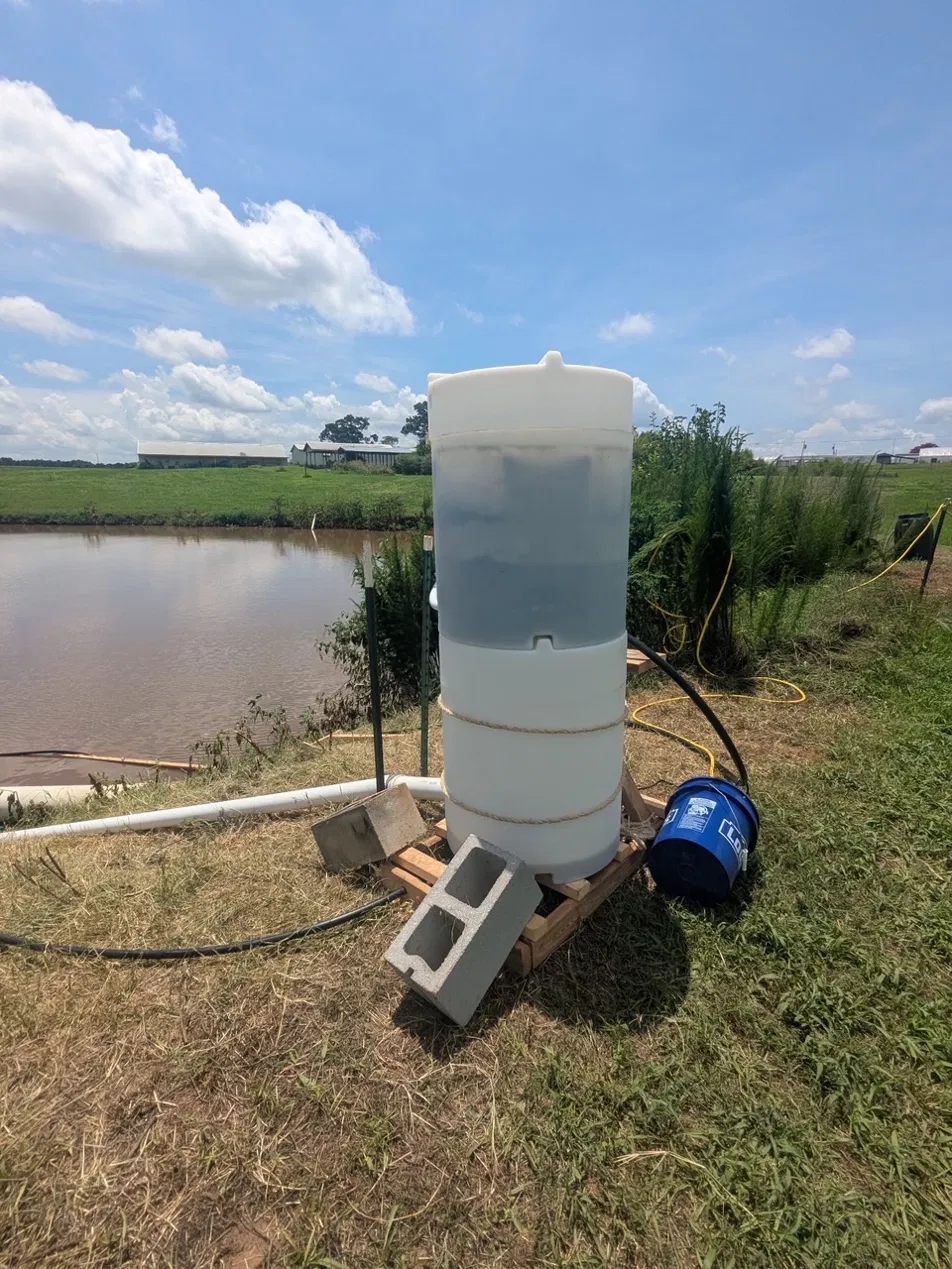
The NutriFilter™
A solar-powered biofilter that removes nitrogen and phosphorus from stormwater ponds.
Nitrogen and phosphorus are what feed algae blooms. The NutriFilter™ draws pond water through a media bed colonized by beneficial bacteria. A controlled fill-and-drain cycle switches the bed between oxygen-rich and oxygen-poor conditions, so a single unit converts ammonium to nitrate and then nitrate to harmless nitrogen gas. Nitrogen leaves the pond for good instead of being moved somewhere else. Dissolved phosphorus is captured and held in the media.
How it works
-
Draw in.
Nutrient-rich pond water is pumped into the media bed.
-
Convert.
In the oxygen-rich phase, bacteria turn ammonium into nitrate. In the oxygen-poor phase, they turn nitrate into nitrogen gas, which escapes to the air.
-
Capture and return.
Phosphorus stays bound in the media, and treated water flows back to the pond.
Schematic, not to scale. Media composition and cycle timing are proprietary.
Built for real ponds
Solar-powered.
No grid connection required.
Passive operation.
No chemical dosing.
Retrofits existing ponds.
No earthwork.
Modular.
Units scale to pond volume and nutrient load.
Units can float on the pond, stand in shallow water or sit on the bank, and can be planted to add habitat and improve the look of the pond.
Proven in controlled trials
Prototype mesocosm
340 L spiked pond water · 86 days
~100% ammonium (NH₄⁺) · 98.2% nitrate (NO₃⁻) · ~100% phosphate (PO₄) removed
Oxygen-dynamics mesocosm
High-concentration spiked water · 26 days
99.5% ammonium (NH₄⁺) removed; oxygen drawdown confirmed to drive denitrification
Outdoor pond trial
In-situ pond · 2023
Nitrogen removal and phosphate adsorption confirmed in the field
Results from controlled mesocosm trials and a 2023 outdoor pond trial. Performance in the field depends on pond conditions.
Under independent study at NC State University.
NC State University's stormwater program, in the Department of Biological & Agricultural Engineering, is evaluating the NutriFilter™ on two City of Wilson stormwater ponds that receive commercial runoff. Water entering and leaving each pond is sampled over at least 15 storm events, with and without NutriFilter™ units, to isolate what the device adds. The goal is a North Carolina DEQ stormwater credit through the state's NEST program and a sizing method engineers can specify statewide.
Baseline monitoring since 2024 · NutriFilter™ installation fall 2026 · NEST submission to follow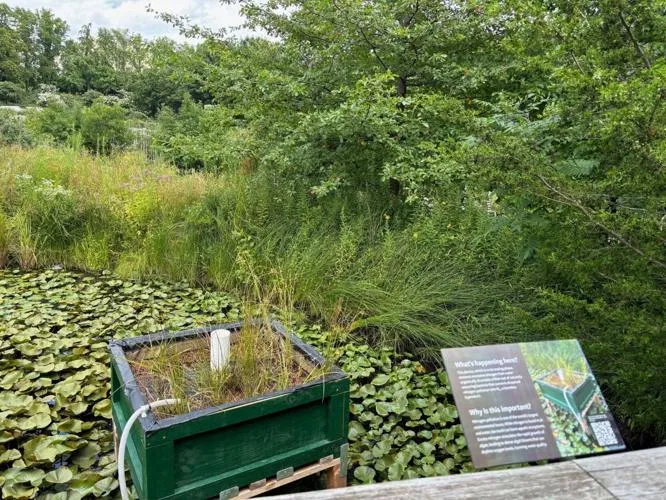
Have a pond that needs more nutrient removal? Let's talk about a NutriFilter™ for your site.
Or call (252) 568-2648. · Read the April 2026 press release (PDF, 1 page)